
AI & ML
Jev by TypeSafe AI: How System One Redefines Automation
Jev is TypeSafe AI's first public “System One” model: instead of text, it returns typed, calibrated decisions in 70–500 ms. We break down the architecture, the Choice, Score and Noul primitives, and real-world use cases.
In this article
Short answer: Jev is not a chatbot but a frontier-intelligence function call. It ingests unstructured state and returns typed, probabilistic decisions that software can use without parsing or validation.
Key takeaways
- Jev returns typed, probabilistic decisions instead of text — schema matching is guaranteed
- The parallel sampler and RLCD training deliver 70–500 ms latency and calibrated confidence
- Three primitives — Choice, Score, Noul — can be asked together in a single request
- $42 per billion input tokens, output tokens are free
Introduction: Beyond the Chatbot Paradigm
The transition from “chatting” to “doing” has long been the primary bottleneck in AI-driven automation. Large language models (LLMs) have achieved superhuman conversational performance, but their architecture — optimized for human-preferred prose — is ill-suited to the rigorous, structured requirements of production software.
Diogo Almeida, a founder of TypeSafe AI whose research at OpenAI helped lay the foundation for ChatGPT, spotted this gap: sequential text-generation models lack the speed and reliability needed for autonomous decision-making. TypeSafe's answer is Jev, the first public “System One Model”. It is described in The TypeSafe Manifesto (opens in a new tab) and the Official Launch Blog (opens in a new tab).
The Architecture of Decision: System One vs. System Two
The name nods to Daniel Kahneman's Thinking, Fast and Slow, which splits human cognition into System 1 (fast, intuitive, automatic) and System 2 (slow, deliberate, logical). Jev is a radical departure from the System 2-like reasoning of LLMs, built on two innovations.
Parallel Sampling. Traditional LLMs generate one token at a time in an autoregressive loop, which is slow and resource-heavy. Jev uses a Parallel Sampler that generates all outputs in a single query. This lets it answer multiple independent questions about one state simultaneously, without the latency typical of sequential generation.
RLCD (Reinforcement Learning for Calibrated Decisions). Most LLMs are tuned via RLHF to produce text humans find pleasing. Jev is trained via RLCD, which prioritizes “epistemically honest” probabilities. That means calibration: the model's confidence (e.g. 0.8) is a direct proxy for the statistical likelihood of being correct.
Technical Specifications and Performance Benchmarks
Jev is optimized for a utility-scale intelligence profile that current frontier models cannot replicate in high-volume decision-making tasks. Compared with existing LLMs:
| Parameter | Existing LLMs | System One (Jev) |
|---|---|---|
| Optimization | RLHF / RLVR (human preference) | RLCD (calibrated decisions) |
| Output | strings / autoregressive text | type-safe structured values |
| Sampling | sequential (token by token) | parallel (single query) |
| Reliability | hallucination risk, parsing required | guaranteed schema matching, zero type errors |
According to Workflow Evals (opens in a new tab), Jev is 193.6x faster and 444.6x more cost-effective than frontier models like GPT-6 Astra or Fable 5.1 in complex automation workflows. The authors themselves call these figures the higher end of real-world gains; for comparable intelligence they cite a typical speedup of 40x–200x.
- 64k
- input tokens
- context window
- 70–500 ms
- latency
- up to 200x faster than traditional frontier models
- $0.042
- per MTok of input
- $42 per billion tokens
- $0
- output tokens
- “too cheap to meter”
The Functional Primitives: Choice, Score, and Noul
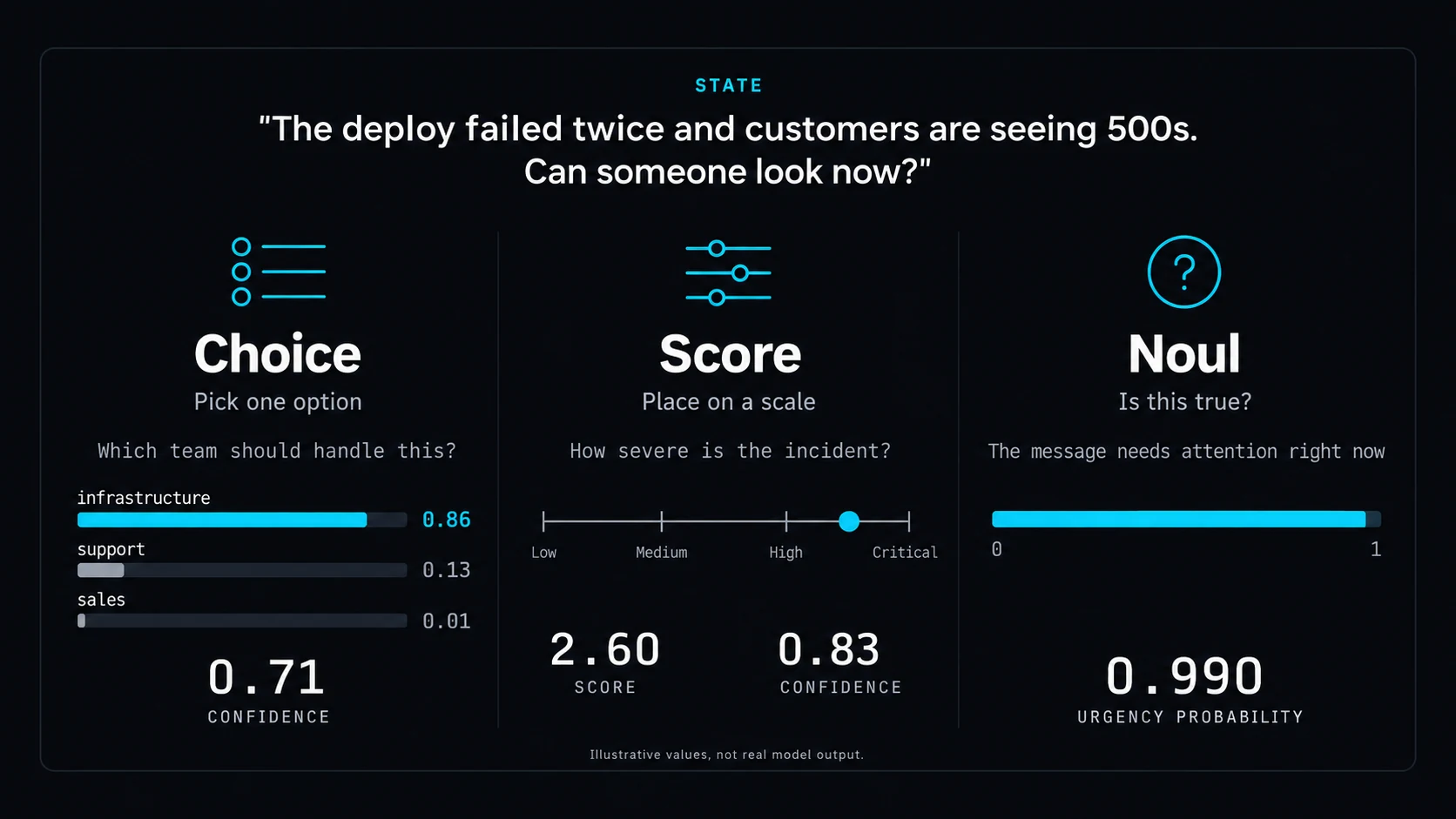
Jev interacts with software through three types of “Question”. The parallel sampler is physically constrained by a predefined schema, making it mathematically impossible for the model to produce a type error or a value that doesn't fit the structure. Before asking questions, developers define the State, which can include raw text, structured data, or LangChain messages.
Choice
Selects from a predefined set of options. Returns a probability for each option and an overall confidence score. Jev supports up to 255 choices. For higher-cardinality tasks it uses a two-stage system, scoring independently before making an explicit choice, to maintain precision. Example: sorting emails into Work, Marketing, Finance, or Security.
Score
Rates inputs against ordered levels (e.g. Low, Medium, High, Critical). Unlike discrete classification, it returns continuous distributions and values on a developer-defined scale, allowing fine-grained ranking by importance or urgency. Example: the urgency of a support request or the quality of a lead.
Noul
A probabilistic yes/no answer to a specific statement (e.g. “Is this a phishing scam?”). It returns the direct probability, from 0.0 to 1.0 (e.g. 0.999), that the statement is true. Example: whether an email is a scam or a proposed system command is dangerous.
Who Jev is for — and who it isn't
Use Jev for
- Smart if-statements: classification, ticket routing, lead scoring and branching business logic in code
- Real-time apps where the UX depends on minimal latency (70–500 ms)
- Guardrails: instantly judging whether a prompt or tool call is safe before an agent acts
- Autonomous agents and bots: browser agents, game bots, algorithmic trading signals
Stay on a regular LLM for
- Free-form text: chatbots, copywriting, writing code
- Human-in-the-loop work: copilots and conversational assistants
- Step-by-step reasoning out loud (chain-of-thought)
How Jev differs from classifiers and regular LLMs
Versus classic ML (BERT, scikit-learn). Classic classifiers need a labeled dataset and training for every task. Jev reads natural-language context of up to 64k tokens with frontier-level understanding, so you describe the question instead of training a model.
Versus structured output from GPT or Claude. A regular LLM writes its answer token by token — including the JSON — so it spends slow, paid output tokens and can still break the format or invent a parameter. Jev does not generate strings at all: a parallel sampler computes probabilities for every predefined question at once, and the answer always matches the schema.
What calibration means in practice. If Jev reports 0.8 confidence, it should be right in about 80 of 100 similar cases, while regular LLMs are often overconfident. To check it on your own data, run Jev over a labeled sample and compare its confidence with the actual accuracy.
Alternatives worth considering
Classic ML models
BERT, RoBERTa, FastText, scikit-learn — cheap to run, but they need data collection and training for each task.
Structured outputs and function calling
A regular LLM from OpenAI or Anthropic constrained to a JSON schema. Flexible, but slower and billed per output token.
Small prompted LLMs
Lightweight models such as Llama 3 8B prompted to classify — cheaper than frontier models, but still generating text token by token.
What Jev can't do
Jev trades text generation for speed and reliability. That has clear consequences:
- No text generation. It cannot write even a single sentence or chat reply.
- No chain-of-thought. There is no visible step-by-step reasoning to read.
- No tool execution. It can judge whether a tool call is safe, but it does not make the call itself.
Real-World Applications and Prototyping
Jev's high-speed, low-cost intelligence profile enables use cases that were previously economically or technically unfeasible.
Enterprise workflows. Jev excels at high-volume triage: demonstrations show it processing between 500 and 1,700 emails in seconds for pennies. Agencies also use it for instant lead scoring, ranking inbound queries by quality for immediate routing.
Agentic infrastructure. Jev acts as a “traffic cop” for model routing, selecting the least costly model (e.g. a “Nano” model for simple lookups) for a task. In “Auto Mode” it acts as a guardrail, detecting risky bash commands or tool calls before an autonomous agent executes them.
The “Doom” bot
a reactive agent making 10 decisions per second based on game state
Wikiracing
navigating Wikipedia paths by analyzing hundreds of links per step without hallucinations
Browser automation
complex end-to-end tasks, such as booking a flight from Zurich to London, in just 7 seconds
Financial services
live trading signals for Bitcoin or stocks — buy/hold/sell decisions from live data feeds, with confidence scores
Developer Integration and Ecosystem
Jev is designed to slot into the modern AI stack as a deterministic component. The langchain-typesafe package provides TypeSafeClassifier, ideal inside agent loops for fast decision-making while reserving slower, expensive LLMs for final prose generation. In the example, the classifier receives the state “The deploy failed twice and customers are seeing 500s. Can someone look now?” and a Noul question “Does this need attention right now?”, and the calibrated urgency probability is read directly from response.nouls["urgent"].noul.
Alternative access is via the Vercel AI Gateway (opens in a new tab) with a standard API key, which simplifies integration for web applications. For deeper implementation guides, see the Official Documentation (opens in a new tab) and the API Console (opens in a new tab).
from langchain_typesafe import Noul, TypeSafeClassifier

# Initialize the classifier
classifier = TypeSafeClassifier()

# Invoke with a state and specific questions
response = classifier.invoke(
    state="The deploy failed twice and customers are seeing 500s. Can someone look now?",
    questions={
        "urgent": Noul(instructions="Does this need attention right now?")
    },
)

# Access calibrated probability directly
urgency_score = response.nouls["urgent"].noulGetting started
Get an API key
Create one in the API Console (opens in a new tab), or use Jev through the Vercel AI Gateway (opens in a new tab) with a standard key. Store it as the TYPESAFE_API_KEY environment variable.
Install the integration
For Python, run pip install langchain-typesafe. The package includes TypeSafeClassifier, plus ModelRouterMiddleware and AutoModeMiddleware for model routing and guardrails.
Describe the state
Pass raw text, structured data or LangChain messages.
Ask your questions
Choose Choice, Score or Noul for each question — all in one request.
Read the probabilities
Use the typed result directly in your code, for example response.nouls["urgent"].noul.
Conclusion: The Jevons Paradox and the Future of Intelligence
The model is named after William Stanley Jevons, the economist who observed that as a resource (like coal) becomes more efficient to use, its total consumption increases rather than decreases. TypeSafe AI posits that by dropping the cost of “System One” intelligence by several orders of magnitude, we will see a massive diffusion of AI into every layer of software.
By providing a type-safe interface that software can finally depend on, Jev shifts AI from an unreliable conversationalist to a reliable, invisible engine of global automation. Intelligence is no longer a bottleneck; it is an interface.
FAQ
Is Jev an LLM?
No. Jev reads natural language like an LLM, but it doesn't generate text token by token. It returns only structured decisions with calibrated probabilities.
What does System One mean?
The name comes from Daniel Kahneman's Thinking, Fast and Slow: System 1 is fast, intuitive decision-making, as opposed to the slow, deliberate reasoning of System 2.
How much does Jev cost?
Input tokens cost $0.042 per million ($42 per billion). Output tokens are free. See the [API Console](https://console.typesafe.ai/) for full pricing.
Can Jev hallucinate?
It can't invent data types, JSON structure or text, because answers are constrained to your schema. Like any model it can still be wrong about a value — that is what the calibrated confidence score is for.
How do I connect Jev through LangChain or Vercel?
In LangChain, use the langchain-typesafe package and its TypeSafeClassifier. On Vercel, the model is available through the [Vercel AI Gateway](https://vercel.com/ai-gateway) with a standard API key.
Related news
- Custom Website Development or Ready-Made Solutions: What to Choose for Your Business
Custom development or ready-made solutions (templates, builders, no-code) — comparing flexibility, cost, and timelines to help you choose the right approach for your business.
- How Much Does Custom Website or App Development Cost in 2026
How much custom website or web app development costs in 2026, what the cost is made up of, and how to plan your budget.
- How Much Does a Business Website Cost in 2026: Full Price Breakdown
How much a website really costs in 2026 — from a landing page to a marketplace, and what affects the final price the most.
Got a project in mind?
Tell us about it — we'd love to hear what you're building.